
Nuclear Emissions Control: How UF₆ Scrubbers Protect Nuclear Facilities
Discover how specialized wet scrubber systems achieve 99.99% removal efficiency for uranium hexafluoride emissions while maintaining full NRC regulatory compliance in nuclear fuel processing operations.
The Critical Challenge of Nuclear Emissions Control
In the nuclear fuel processing industry, controlling emissions of uranium hexafluoride (UF₆) and related fluorine compounds isn't just about environmental compliance—it's a matter of worker safety, public health, and national security. These highly toxic and reactive compounds require specialized emission control systems that can achieve near-perfect removal efficiency while operating reliably 24/7 in demanding industrial environments.
When a major nuclear fuel processing facility approached CR Clean Air with the challenge of controlling tail-gas emissions from their fluorine-based processing operations, we knew this project would push the boundaries of wet scrubber technology. The stakes were high: any failure could result in regulatory violations, facility shutdowns, and potential health hazards.
The Challenge
The facility needed to control emissions containing fluorine (F₂), hydrogen fluoride (HF), and uranyl fluoride (UO₂F₂) from multiple process streams, achieving removal efficiencies exceeding 99.99% to meet stringent NRC regulations and protect workers from these highly corrosive and toxic compounds.
Understanding UF₆ Chemistry and Control Requirements
Uranium hexafluoride presents unique challenges for emissions control systems:
- Extreme Reactivity: UF₆ reacts violently with water to form highly corrosive HF and uranyl fluoride compounds
- Multiple Contaminants: Process streams contain F₂, HF, UO₂F₂, and trace uranium compounds
- High Flow Variability: Gas flows range from 200-600 ACFM with temperature variations
- Strict Regulatory Limits: NRC and EPA regulations require near-complete removal of radioactive materials
CR Clean Air's Engineered Solution
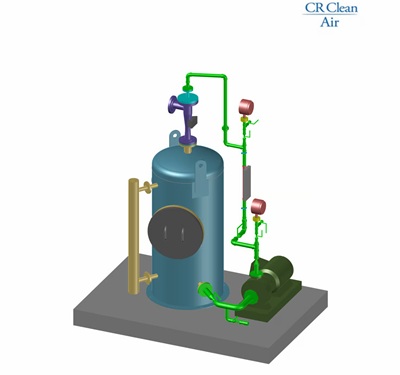
Our engineering team designed a comprehensive three-stage wet scrubber system specifically tailored to handle the unique challenges of UF₆ emissions control:
Stage 1
Jet Venturi Scrubber
High-energy initial contact for rapid UF₆ hydrolysis and fluorine absorption using caustic solution
Stage 2
Packed Tower Absorber
Extended contact time for HF neutralization and uranyl fluoride capture
Stage 3
Mist Eliminator
Final polishing to remove entrained droplets containing trace uranium compounds
Critical Design Features
Several innovative design elements were incorporated to ensure reliable performance:
Advanced Materials Selection
Monel alloy construction throughout to resist the extreme corrosion from HF and fluorine compounds. Standard materials would fail within months under these conditions.
Dual-Stage pH Control
Automated caustic dosing system maintains optimal pH (10-11) for fluorine absorption while preventing uranium precipitation that could foul the system.
Continuous Monitoring
Real-time fluoride analyzers on inlet and outlet streams, plus uranium monitors to ensure regulatory compliance and optimize system performance.
Proven Results
The system has been in continuous operation since installation, delivering exceptional performance:
99.99%+
Removal efficiency for fluorine compounds
<0.01 ppm
Outlet uranium concentration (far below NRC limits)
100%
NRC regulatory compliance record
24/7
Reliable continuous operation
Key Takeaways for Nuclear Industry Applications
This project reinforced several critical principles for successful nuclear emissions control:
- Materials matter critically: The extreme corrosiveness of fluorine chemistry demands exotic alloys like Monel. Cutting corners on materials leads to catastrophic failures.
- Process understanding is essential: Deep knowledge of UF₆ chemistry and reaction kinetics enabled us to design a system that controls the reaction rates and prevents fouling.
- Redundancy and monitoring provide peace of mind: Multiple measurement points and automated controls ensure the system can detect and respond to process upsets before they become compliance issues.
- Staged approach handles variability: The three-stage design allows the system to handle wide variations in flow, concentration, and composition while maintaining consistent removal efficiency.
The Future of Nuclear Emissions Control
As nuclear energy continues to play a critical role in our clean energy future, the demand for reliable, high-efficiency emissions control systems will only grow. The success of this UF₆ scrubber installation demonstrates that with proper engineering, deep technical expertise, and quality materials, it's possible to achieve the stringent performance requirements of the nuclear industry while maintaining operational reliability.
Whether you're processing uranium fuel, operating research reactors, or managing radioactive waste, CR Clean Air has the experience and technical capabilities to design emissions control systems that protect your workers, meet regulatory requirements, and operate reliably for decades.
 Castings & Forgings
 Bulk Material Handling
 Electrical & Electronic Components
 Flow Instrumentation
 Hardware
 Material Handling Equipment
 Metal Cutting Services
 Metal Forming Services
 Metal Suppliers
 Motion Control Products
 Plant & Facility Equipment
 Plant & Facility Supplies
 Plastic Molding Processes
 Pumps & Valves
 Recycling Equipment
 Rubber Products & Services